Guidance on Family Law from our expert family law solicitors here at Evolve Family Law in Manchester & Cheshire.
We put a lot of family law legal information on our website and if you have a single question about your situation, you should find an answer in this comprehensive collection of advice & guidance on all areas of family law.
If you need a greater level of help, please contact us and one of our team will call you to make an appointment.
We were delighted to support a business breakfast recently with the special guest speaker Economist, Jim O’Neill, Lord O’Neill of Gatley. The event was attended by over 100 guests from the business community, and raised nearly £10,000 for MedEquip4Kids.
Once breakfast and coffee were served, MedEquip4Kids chairman Brian White welcomed Lord O’Neill and gave a brief introduction to his many impressive achievements. After graduating from Sheffield University, Lord O’Neill studied for a PhD at Surrey and went on to become a renowned economist, working for various banks including 15 years at Goldman Sachs Division of Asset Management. He is especially well known for developing the acronym BRIC (Brazil, Russia, India and China), a group of countries considered to be at a similar stage of newly advanced economic development. In 2011 he was named by Bloomberg Markets magazine as one of the 50 most influential financial professionals worldwide.
When Lord O’Neill left Goldman Sachs he had a desire to do something different, though he wasn’t sure at first what that would be. Then he was asked by David Cameron to lead a review into the problem of antimicrobial resistance. His wife, who is a scientist, commented that it was the first time she’d be able to understand and be interested in what he was doing! Lord O’Neill has subsequently co-written a book called Superbugs: An Arms Race Against Bacteria.
After the talk the floor was opened up for the audience to ask questions. Perhaps unsurprisingly in the circumstances, the first topic to be raised was Brexit. Lord O’Neill’s view as a remainer was that there were likely to be negative consequences of Britain leaving the EU, but it perhaps wasn’t the most important issue facing the UK economy at the current time. In fact it was possible that increased productivity could eventually make up for any negative impact of Brexit. But in order to achieve that productivity, it was crucial to tackle geographical and intergenerational inequality – factors he believed were responsible for the referendum result, especially in places like Sunderland where people had felt for decades that they were being left behind compared to other parts of the UK.
This led on to the subject of the Northern Powerhouse, an initiative which Lord O’Neill has championed and remains heavily involved in. In his opinion the six key factors in regenerating the northern economies are: devolution (in particular healthcare – he mentioned that in areas of North Manchester the life expectancy for men is just 59 years old), transport, education, skills, businesses moving out of London to prevent young people in the north having to relocate for jobs, and backing from private sector and council leaders.
Finally Lord O’Neill was asked about the best emerging markets for UK exports, and he emphasised the importance of China. Although its growth has slowed recently, it still creates an equivalent of the South African economy every month. One important area is Chinese consumers: Apple now sells more iPhones to Chinese customers than it does to US ones. Other key emerging markets he noted were Vietnam and Laos.
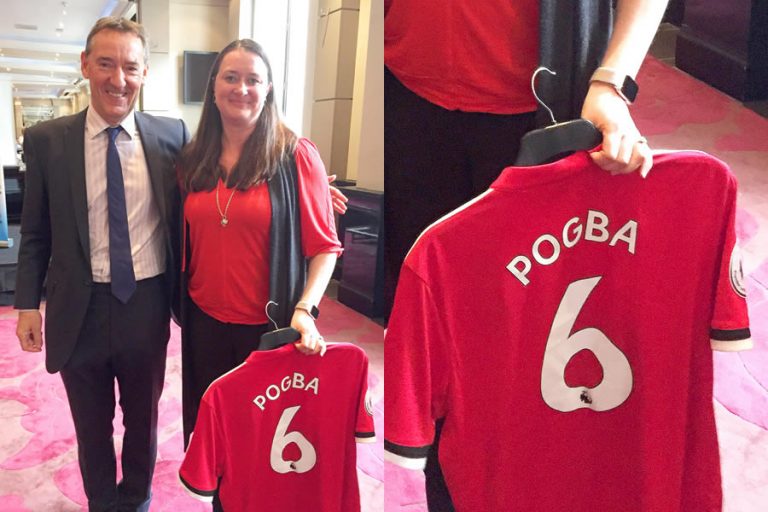
At the end of the breakfast Lord O’Neill, who is an enthusiastic supporter of Manchester United, drew out the winning envelope from the prize draw. The lucky winner was our very own Becky who went away with a Paul Pogba shirt!
[related_posts]
Good news for grandparents – children law reform proposed – to give grandparents a right to apply to Court to see their grandchild.
As a children lawyer I smile when I see a grandparent out with a grandchild. Why? I’m often asked for advice on grandparents ‘rights’ and it is therefore great to see children enjoying time with grandparents.
Sadly grandparent contact can stop if:
There is a family fallout with a son or daughter-in-law;
Parents separate and the parent who is looking after the children thinks that a grandparent took sides during the divorce or wants to exert control;
The death of a child and the remarriage of a son or daughter in law;
Family moving away or going to live abroad.
All too often when families split up grandparents can be forgotten, despite providing support such as:
Continuity and stability in a grandchild’s changing post-divorce world;
Childcare if both parents have to go back to work after a marriage breakdown;
Family historian;
A fun relative and role model.
The current grandparent and child law
Under current children law, grandparents don’t have an automatic right to apply to Court to see their grandchildren. Grandparents have to undergo a two stage process:
Ask the Court for permission to be able to apply for a Court Child Arrangements Order.
If they get permission then apply for an order setting out the time a grandchild should spend with their grandparents. The Order can provide for regular contact or just cover a one off special holiday or the grandchild being able to come to an 80th birthday party or golden wedding celebration.
When a grandparent asks for Court permission to apply for a Child Arrangements Order the Court considers:
The connection with the child (how close are the grandparents to the grandchild);
The nature of the application for contact;
Whether the application might be potentially harmful to the child's well-being in any way.
Although it is usual for a Court to give permission for a grandparent to apply for a Child Arrangements Order the two stage Court process can be off putting to a grandparent desperate to see their grandchild. Once permission to apply for the Court order is granted the Court then has to decide whether contact is in the child’s best interests.
[related_posts]
The proposed grandparent reform
According to press reports the proposed change to the children law is to do away with the need for grandparents and other close family to have to ask the Court for permission to apply for a Court order to see their grandchild.
https://www.dailymail.co.uk/news/article-5697961/Grandparents-right-grandchildren-parents-split-new-law.html
If the law is changed then grandparents will be treated in exactly the same way as a parent asking for a Court order to see their child. The reform has long been advocated by people’s campaigner and grandmother, Esther Rantzen. If the law is reformed it will make it easier for grandparents to see their grandchildren and grandparents will have the same ‘’rights’’ as parents to apply to stay in touch with their loved ones.
For help with any aspect of children law please contact us
Surrogacy reform is on the cards with Law Commission review on surrogacy
There is nothing quite like welcoming a new baby into the world. As a children lawyer I have been privileged to help parents secure Parental Orders after they have had a child through a surrogacy agreement. I therefore know just how stressful the months leading up to the birth of the child are as well as the worry of how quickly a parent can secure a Court order. For many parents they couldn’t relax and enjoy their baby until all the legalities were sorted out.
Surrogacy laws were first introduced about 30 years ago. Society and the medical options available to couples have changed over the years. Many parents, medics and legal professionals have concluded that the current surrogacy legislation, once thought to be ground breaking, is no longer ‘’ fit for purpose’’ and doesn’t meet the needs of the surrogate, the parents and, most importantly, the baby.
Under current English law a surrogate mother is the legal mother of the child even if she has no genetic link to the baby. A Parental Order, in favour of the parents, can only be applied for after the baby has been born and various conditions have to be met, namely:
The application must be made within six months of the child’s birth;
The surrogate mother must fully consent to the Parental Order and must understand that she will be giving up parental rights;
No payment should have been made to the surrogate mother save for necessary reasonable expenses. The Court can give retrospective approval to payments over and above reasonable expenses;
There must be a genetic connection between the child and at least one applicant for the Parental Order;
At the time of the application and the making of the order the child’s home must be with the person applying for the order;
Either or both applicants must be domiciled in the UK
There is a concern amongst professionals that current UK surrogacy laws and conditions encourages the use of international surrogates where, in some countries, there is less regulation and protection for all participants.
[related_posts]
The Law Commission reforms will consider changes to the law relating to:
the legal parentage of the baby;
the regulation of surrogacy including payments;
the rights of the child to obtain information about their origin and the surrogacy arrangement;
the rights of the surrogate, parents and child and how best to avoid exploitation in the surrogacy process.
The Commission says that a report on proposed changes in the law will be available within a year. There will then need to be an impetus to get any recommended changes in current surrogacy laws into new legislation so that all involved in surrogacy arrangements feel that the law is working to protect them and the child.
For help on any aspect of children law please contact us
Is it a gift or a loan? Helping your children on the property ladder.
In an age where a lot of young people and divorcees recovering from the financial split from their spouse can’t get on the property ladder without help from the ‘’bank of mum and dad’’ a reported case in the Daily Mail highlights the importance of recording agreement over property.
The reasons behind why Mr and Mrs Joy gave their daughter £90,000 are complex but in essence the Joy family dispute was simple: was the £90,000 payment a loan, as claimed by Mr and Mrs Joy, or a gift, as asserted by their daughter, Lucy.
https://www.dailymail.co.uk/news/article-5669857/Bitter-rift-bank-mum-dad-Couple-lose-90-000-loaning-daughter.html
After a Court battle a judge has recently ruled that the money was a gift and is not repayable by the couple’s daughter, Lucy. This is despite Mr and Mrs Joy reportedly re-mortgaging their family home to raise the £90,000 for their daughter on the basis of an alleged verbal agreement that Lucy would then transfer an inherited property into Mrs Joy’s name. The key factor in the Court decision was that there was no written agreement or contract between parents and child.
As a family solicitor I am often told by clients that they don’t need a written agreement or document between their family members. The Joy case is a salutary reminder of the importance of writing things down. That is not just because family can fall out but also to protect family members from:
The donor’s estate being liable for extra inheritance tax as the HMRC might not view a payment to a family member as a ‘’gift’’ without formal evidence;
The person receiving the money facing a financial claim on divorce and therefore needing to establish that money received from family was a gift to them as an individual or a repayable loan;
The person receiving the money facing bankruptcy or a Court judgement – without a written document a third party or a Court may not accept that the money was a loan and not a gift.
[related_posts]
There are many different ways in which family property agreements can be recorded, such as:
Cohabitation agreement between cohabiting couples;
Declarations of trust between joint owners;
Loan – not secured on the property ;
Mortgage – secured against the property ;
Prenup agreements between an engaged couple;
Postnup agreements – suitable for a married couple who acquire property after marriage, for example, inherited from a parent;
Record of gift of property or deposit to purchase a property.
Whatever the type of document and however the paperwork is drawn up, the important thing is that there is a written agreement. By spending the time recording the property agreement a lot of time and money can be avoided when it comes time for the loan to be repaid, the property sold or the estate sorted out. The English philosopher, John Locke, said ‘’where there is no property there is no injustice’’. I say ‘’ where there is a written agreement on property there’s normally no injustice’’.
For help with family agreements and estate planning please contact us
Recently there has been a lot of discussion on whether male infant circumcision should be banned unless the procedure is carried out on medical grounds.
Why the debate? It flows from the media discussions and press coverage on the banned female genital mutilation and the news that the Icelandic government is proposing legislation to outlaw male circumcision for anything other than non-medical reasons. Now anti-circumcision advocates are asking the British Medical Association to add support to their call for a change in UK law to stop male circumcision unless it is carried out on medical grounds.
Male infant circumcision is an important passage for those of the Jewish or Islamic faiths but according to a recent You-Gov poll 62 per cent of people in Britain support a new law banning infant circumcision.
Under current UK law and BMA guidelines both parents must give informed consent for what is termed non-therapeutic or ritual circumcision. If parents can't agree on whether or not their child should be circumcised a doctor should not carry out the procedure without a family law Court order. In some situations children are old enough to express their views and, if so, their wishes must be taken into account. When parents are separated or divorced it is sometimes impossible to reach a consensus view on what is best for their child.
The Court application for circumcision
So, what happens if parents can't reach agreement on whether their child is circumcised or not? The Court procedure is exactly the same for a situation where parents can't agree on whether their child should have any other type of operation or if parents can't agree on the school their child should attend or the religion their child should practise.
Either parent can apply to the family Court for what is known as a ‘’specific issue order’’ for a judge to decide on whether the child should be circumcised, undergo any other medical procedure or determine the choice of school or religion.
[related_posts]
How does a judge decide what is best for a child?
The judge has to consider what is in the child’s best interests. In a case called Re S a judge decided that it was the mother’s need to portray herself as a religious person that was behind her desire to have her 8 year old son circumcised , against the father’s wishes, and the Court application was refused. The rationale behind the refusal was that it is the child’s best interests and needs that are paramount, not the parent’s needs. Each Court decision will turn on the individual family circumstances and, in many situations, a judge is likely to rule in favour of circumcision after taking into account a range of welfare factors.
If there is a change in the law regarding male circumcision or there is a ground swell of public opinion away from male circumcision for non-medical reasons judges may be less ready to determine that the procedure is in the best interests of an infant child.
For help with any aspect of children law please contact us
Spousal maintenance is always a thorny topic, in many cases the person making the payments thinks that they are paying too much and for too long and the person receiving the spousal maintenance thinks that they are getting too little, taking into account child care responsibilities, lifestyle during the marriage or lack of qualifications or career experience over a long marriage.
A husband and wife locked in a Court battle over maintenance payments after their separation in 2012 hit the news after a Court of Appeal ruling. The couple, William Waggott and his former wife, Kim Waggott split up in 2012, after a 21 year marriage. Mr Waggott was ordered to pay his wife a lump sum of nearly 10 million and spousal maintenance for life at the rate of £175,000 a year. The one thing that the husband and wife were agreed on was that the original Court ruling was unfair; the husband thinking that spousal maintenance for life gave Mrs Waggott no financial incentive to get a job and the wife thinking the amount was too low and needed to be adjusted by the date of the Court of Appeal hearing to take into account cost of living increases and Mr Waggott’s income.
The battle lines were drawn with Mr Waggott applying to Court to stop the spousal maintenance for life and Mrs Waggott asking the Court for more maintenance. The Court of Appeal has ruled that Mrs Waggott’s spousal maintenance payments shouldn’t continue for life but instead end in three years’ time. The Court has also said that the amount of maintenance won't increase. As well as losing her spousal maintenance in three years Mrs Waggott also faces substantial legal costs.
Reasoning behind the Court decision
Mrs Waggott argued that her former husband's earnings capacity had been created during their 21 year marriage and that it was only right that she should continue to share the fruit of the marriage as her ex-husband's ongoing income was still a ‘’matrimonial asset’’.
It was also argued, on Mrs Waggott’s behalf, that she should not have to invest some of the near 10 million she had received in 2012 to generate an income for herself, instead of getting ongoing spousal maintenance. It was said that would mean she was using her share of the capital of the marriage to live off when the 10 million was her entitlement to the family assets generated during the marriage.
Mr Justice Moylan ruled that the former husband's future earnings capacity is not a ‘’matrimonial asset’’ and accordingly it doesn’t have to be shared with Mrs Waggott and that the wife could invest some off her lump sum and live off the interest or get employment.
The Court is always keen to achieve what is known as a ‘’financial clean break’’ to sever the money ties between a husband and wife as soon as possible after a divorce. That will be achieved in the Waggott’s case in three years’ time when the maintenance payments stop.
[related_posts]
What does the ruling mean?
In the press the Waggott Court of Appeal decision has been hailed as a victory for bread winners and the end of ‘’the meal ticket for life’’ of spousal maintenance.
Does the decision mean that? The leading judge was careful to say that he acknowledged that long term maintenance can be required as part of a fair outcome in a divorce . There is therefore a danger in saying that the Waggott decision means there will be an end to spousal maintenance for life.
In Mrs Waggott’s case she had received nearly 10 million and both she and her former husband had bought new houses for about 2 million each. That meant Mrs Waggott still had capital and, as importantly, had previously enjoyed a good career and so she could, in the judge’s opinion, adjust to the termination of her spousal maintenance payments without undue hardship.
That won't be the case for many families where the economically weaker spouse has used all of their capital sum to pay for a new house, perhaps with a mortgage, and therefore doesn’t have the option of living off interest or the prospect of getting a well-paid job that will pay enough to cover the mortgage and bills.
The frustrating thing about family Court decisions is that whilst they lay down principles of law the principles can't be applied rigidly to every family situation. Each Court decision is based on the individual’s personal and financial circumstances. That is why it is so important to get objective legal advice on what a ruling might mean for you and your family. Why? Because there is normally a range of Court orders that a Court could reasonably make in a given family situation rather than one ‘‘right answer’’. That’s why Court litigation is such a lottery as there is always a risk that you could be a loser in a Court battle.
In light of this decision many breadwinners will want to review whether they should apply back to Court to stop their spousal maintenance payments for life and others will want advice on how to negotiate a clean break figure following the Court ruling. Equally those receiving spousal maintenance will need legal advice as Mrs Waggott’s case is a clear reminder, to both husband and wives, of the risks and costs of Court litigation.
For help with any aspect of divorce and family finances or changes to an existing spousal maintenance order please contact us.
For one mother there was a happy ending, all thanks to the Court of Appeal. The appeal judges decided to reverse an earlier Court’s decision that said two children should be returned to the USA whether or not their mother could get a visa to re-enter the States.
The family Court appeal made all the difference.
The family Court appeal centred on whether two children, age 5 and 3, should return to their country of birth, the USA, at their father’s request under a Hague Convention Court application. The mother had taken the children to England, the country of her birth, without a USA Court order or the father’s agreement, after marriage difficulties made her conclude that she and the children should live in the UK. If the mother had realised the complexity of the immigration issues facing the father and herself she may well have thought twice and not taken the children out of the USA.
For the children immigration wasn’t a problem as they had dual citizenship, having been born in the States and having British citizenship through their mother. The children’s Pakistani father was classified as an illegal over-stayer in the USA and if he decided to come to the UK to challenge Court rulings or to see the children he faced not being able to get back into the States, a country that he had called home from the age of 12. For the mother, as a British citizen who had entered the USA on a temporary visa and married the father in the States, it was unlikely she would be able to get a visa to go back to the States.
The situation of both parents was stark. If the father ‘won’ his Hague Convention application and the Court ordered the return of the children to the States to enable the USA Court to decide on what was in the children’s long term interests, then the mother was unlikely to get a visa to go back with them. The High Court ruled in the father’s favour and the mother felt she had no alternative other than to appeal.
The Court of Appeal then faced the dilemma of deciding if the children would be exposed to a grave risk of harm if returned to the USA under the Hague Convention. The mother ran this argument as there are limited defences available to try and stop a Hague Convention ordered return. The Appeal Court concluded that the children could not be removed from their primary carer despite the fact that the mother had created the situation that the family found itself in and even though the Appeal Court decision made contact between father and children problematic given his precarious immigration status in the USA.
[related_posts]
The family circumstances may appear unusual but as a child abduction solicitor I often have to investigate the immigration issues that arise after a child has been taken out of or has entered the UK and present the best possible evidence on immigration status and attachment. It is vital to do so as immigration status can be the key to the Court decision, as it was in this case as the children’s attachment to their mother as their primary carer, meant they would be at risk of harm in returning to the States without her. Would you risk it? The High Court decision, reversed by the Court of Appeal, shows just what a risk was taken. Sadly though there are no winners or losers in this family situation as the father now faces the same immigration dilemmas and difficulties in seeing his children.
For help with child abduction or children law please contact us
In the immediate aftermath of a parental separation it can feel devastating to not be there every night to read a bedtime story to your child or, if they are older, to help them with their homework. Imagine how much more difficult it is to come to terms with a separation if one parent announces their decision to move abroad with a child. It’s highly unlikely that the parent left in the UK will be able to continue to see the child each week, take the child to ballet or football practice or to be there as a taxi service after the first school dance.
I may paint a vivid picture but that is the reality for the parents I represent in child relocation applications. As a specialist children and child abduction lawyer I am in the privileged position of meeting parents and getting a snapshot of their family lives. That’s necessary to help me gain a real appreciation of why a parent is desperate to move abroad with their child or how not only a parent but the child’s extended family will be effected if a child does move abroad.
What happens if a parent objects to a move abroad?
If one parent wants to move abroad and the other parent objects there are a number of alternatives:
The parent can still move abroad – they just can't take their child with them unless they get the other parent’s agreement or Court permission;
The parent could take the child abroad without agreement or Court order – that may amount to a criminal offence under child abduction law and ultimately could lead to the child’s removal from the parent;
The parent could apply to Court for permission to take the child abroad to live or the other parent could apply to Court for an order prohibiting the child’s removal from the UK.
Even after Court proceedings have been started it can sometimes be possible to reach an agreement over whether a child should move abroad. It is my job when representing parents facing an application for a child to live in a foreign country to weigh up the chance that the Court application will be successful, and if the prospects are high, to negotiate the best contact arrangements.
How does a Court decide my child’s future?
Whether the Court is deciding on whether your child should move to France or Bermuda or if the child should live with you or their other parent the Court has to look at what the judge thinks is in the child’s best interests taking into account a set of criteria known as the ‘’welfare checklist’’.
When a judge makes the decision if a child should relocate abroad the child’s interests aren’t paramount as the Court has to consider the effect of granting or refusing the application on both parents. That is why it is so important for a solicitor to know all about family life and not only what the child will gain and lose by a move abroad but how the Court decision will impact on each parent.
A parent refused permission to take their child to their country of origin and where all their extended family still live may find the Court refusal more difficult to accept than a parent who wants to move for lifestyle choices or because they have found a new job based abroad.
No two parents are the same and even if the parents of two children in different families have the same amount of contact with their child each week the emotional effect of a move on the parent left behind can be very different; one parent may quickly adapt to travel abroad to see the child and the other may become depressed and unable to come to terms with the Court decision.
Although the Court is focused on the child’s needs as a lawyer it is my job to not only to look at the Court criteria in relation to the child but also the impact of a decision on the parent I am representing. That’s because if either parent is devastated by the Court decision and can't come to terms with the ruling then it is bound to have a negative impact on the child. That is something that a Court needs to consider when deciding whether it is in a child’s best interests to move out of the UK.
[related_posts]
What next?
If you are a parent contemplating a move abroad with a child or a parent facing a potential Court application then the best option is to get legal advice. The sooner a parent gets specialist advice on the pros and cons of making or opposing a Court application and what steps they and their lawyer will need to do to successfully get permission or to oppose an application the better. It is like many things in life: tomorrow belongs to those who prepare for it today.
For help with the process of taking a child abroad to live or for help in opposing an application please contact us
The Child Maintenance Service, the government organisation tasked with assessing and administering the statutory child support regime, frequently gets bad press for its bureaucracy and the intricacy of its rules and regulations surrounding the payment and enforcement of child support.
A recent Court decision has hit the headlines because the Court of Appeal has said that a father’s sole source of income can't be classed as earnings upon which to calculate how much child support should be paid. The first two child support tribunals took the approach that if someone lives off an income then it can be viewed as ‘’income’’ but on an appeal by the father and by the Secretary of State for Work and Pensions the Court of Appeal disagreed.
You may question when income isn’t ‘’income’’ but the Court of Appeal decided that income for child support purposes should be considered in light of rulings on what is classed as income for tax purposes.
In this family, the father derived his entire income from professional gambling, namely bets on the horses and cards. Under income tax rules and regulations earnings from gambling are not treated as self-employed taxable income even if they are a person’s only source of financial support. The Court ruled that the definition of earnings to assess liability for child support is the same as assessing eligibility for welfare benefits or liability to pay income tax.
The Court ruling may make logical sense to the Department of Work and Pensions but where does it leave the parent who requires child support for their children when the other parent is earning a living from gambling or another non-taxed source?
Critics have long argued that assessing child support using a statutory rigid scheme leads to these types of anomalies and that these situations were avoided when the Court had the power to order child maintenance based on what a judge thought was the right amount to meet the child’s needs.
With any process there are always winners and losers and for some the Child Maintenance Service has simplified the child support process and made the collection of child support more straightforward, taking the worry out of relying on an ex-partner for child maintenance. For others, particularly where their former partner or spouse is self-employed or lives a lifestyle that doesn’t seem consistent with their taxable income the child support regime and government agency has made life more complicated than relying on the old Court system for assessing child support.
[related_posts]
You may think that there are very few professional gamblers so the Court of Appeal decision won't affect many children. However the rules do apply to other scenarios such as the investor living off capital gains rather than dividend income or the more common situation of a self-employed person’s reported income not appearing to reflect the reality of their daily expenditure.
As a children lawyer this case emphasises the importance of getting expert legal advice when parents separate and to not sort out financial matters on a piecemeal basis. Often a husband or wife will want to agree on a split of the proceeds of sale of their house so that they can each rehouse themselves leaving issues such as spousal maintenance or child support to be agreed later on. That can lead one parent as the financial winner and the other as the financial loser if, as a result of the child support rules and regulations, the child support payments are assessed at a lot lower figure than was anticipated when committing to the new house. As frustrating as it is to wait and sort out all financial matters together the gamble of dealing with child support in isolation just isn’t worth it.
For joined up advice on children law and child support please call me on +44 (0) 1477 464020 or email me at louise@evolvefamilylaw.co.uk
Louise Halford
Mar 26, 2018
Getting in contact with Evolve Family Law could not be easier.
We put a lot of legal information on our website and if you have a single question about your situation, you should find an answer in our blog here.
If you need a greater level of help, please use this form and one of our team will call you to make an appointment. Please note that we cannot offer Legal aid.
Unfortunately due to the level of single question enquiries we receive, we cannot guarantee to provide written answers to individual questions posted via this enquiry form.